Showing posts with label Writing. Show all posts

Thursday, June 28, 2007

Watchman, What Of The Night?


I am, for the third time, reading "Nightwood" by Djuna Barnes. I bought myself a first American edition of the book, and the size of the hardcover is a luxury in the hand.
In all the preparations for the upcoming show, i have little to say about painting. Suffice it to say this book remains a very significant influence on my work.
From the most unbelievable chapter of the book, in Paris as Dr. Matthew O'Connor gives his long monologue to the American Nora Flood on the night and loving Robin Vote:
"The French have made a detour of filthiness - Oh God the dirt! Whereas you are of a clean race, of a too eagerly washing people, and this leaves no road for you. The brawl of the Beast leaves a path for the Beast. You wash your brawl with every thought, with every gesture, with every conceivable emollient and savon and expect to find your way again. A Frenchman makes a navigable hour with a tuft of hair, a wrenched bretelle, a rumpled bed. The tear odf wine is still in his cup to catch back the quantity of its bereavement; his cantiques straddle two backs, night and day."(p. 107)*

And later, the doctor is speaking with Felix about his child with Robin, Guido:
"In the average person is the peculiar that has been scuttled, and in the peculiar the ordinary that has been sunk; people always fear what requires watching"(p. 151)*

*New Directions "New Classics", 1937 First Edition

Saturday, May 12, 2007

Calgary Andrew Number One

Always a pleasure to see Andrew Wedderburn, a man not too scared to sleep in my apartment.
He introduced me to the term "dorkestra", in reference to all the glockenspiel and high school band instrument mega-groups this city has pollinated across the land.

Monday, March 26, 2007

Sloppy Seconds Wedderburn


Andrew is the only friend of mine who pointed to comet the night we met.
He has a book coming out on Coach House. He's touring the book, reading; as opposed to his usual tours yodelling with Hot Little Rocket.


Milk Chicken Bomb

The kid sells lemonade. Not a lot of people buy lemonade, especially now that it’s winter, but the kid makes good lemonade, even if his friend Mullen thinks it ought to be sweeter.

They don’t talk much with the other ten-year-olds – most of the others are Dead Kids anyway. Except for Jenny Tierney, but she’s busy breaking kids’ faces with her math book. Besides, the Russians from the meat-packing plant are a lot cooler, and they always win at curling.

But in small-town Alberta, there are just too many roman-candle fights, bonspiels, retaliatory river diversions, black-market submarines, exploding boilers, meat-packing-plant suicides and recess-time lightning strikes for one lonely kid to get any attention. He might as well go to Kazakhstan. Then the adults in his life start disappearing down tunnels and into rendering vats. Being ten is hard enough without all that, especially when your best friend is ruining the lemonade.

But the Milk Chicken Bomb should change everything.

Frenetic, hilarious and gently heartrending, The Milk Chicken Bomb takes us inside the mind of a troubled ten-year-old who is just beginning to understand that the adults around him are as lonely and bewildered as he is in the face of the slapstick demands of the world.

Sunday, March 25, 2007

A conversation with JW Veldhoen: Part Two


Wil Murray:
"The counter method bit is interesting. I though a bit about the cut-up and wonder if it is just a more mechanical extension of what one already does when writing. Moving things around, reading, moving them again. But writing that I wonder if the cut-up extends it to 'looking' instead of 'reading'. A relationship somewhere between viewing and reading.
There's little of interest in the book of essays on John Hawkes I just got, but one thing sticks in my head. The interviewer goes on for a while about the strangeness of Hawke's first book being non-biographical, as most are. He had no grand reply, and described the day that the book was started. I think a lot lately about the lack of importance that I ascribe to the specifics of what I am doing in the studio when "painting is going well". It could just as easily be blue and flat or brown and glossy and there's simply no place that isn't me.
Making fog horn sounds as I wave my hand over some great lump of paint. No one is ever going to do that but me.
I think Hemingway meant his famous words to be about writing in good faith, less than 'if you're going to write a cock, write YOUR cock'. I, just the other month, picked up a brush and started rendering form. I am an unpracticed hack. The only strategy is to be one until I'm not."

JW Veldhoen:
"This(Pascal's Wager) is probably as close as I've ever come to a method for living, and I've used it as advise to myself and for others. If you find yourself lacking belief, perhaps by acting as though you believe, maybe you'll trick yourself. This also allows for the transference of belief, and the wearing of masks. Rilke said people run out of masks, and I hope not to. This of course opens up a whole can of worms regarding self-deception, or bad faith, but I've dumped constant existentialist anxiety for what seem like palliative (a treatment or medicine relieving pain or alleviating a problem without dealing with the underlying cause, from Latin palliativus, from the verb palliare ‘to cloak’) or destructive actions. As for 'write what you know' I guess my point goes to how I practice creative writing, and against how so many think that slavish imitation of life, or observation alone, is a high enough criteria for experiential prose, and how a so-called 'true-story' or a story transmogrified from the base components of happenstance, equals authorial and narrative consistency, or honesty, as a opposed to an elaborate dissemblance (especially one that might take on the appearance of truth to the author) that illustrates a variety of truth (a well-worn chestnut).

And when I wrote, 'a method wherein nothing is moved, cut-up, or transplanted, but is still not a linear narrative... where parts multiply, and organize according to a systemic logic, rather independent of desire, except as reactions.' I was attempting to translate half-digested and voguish theory into something far more elusive and personal. This systemic logic is varied, indecipherably hermetic, and is why I can't really compose a methodology for narrative. I've used formal tricks for effect (anagrams, word games and puns, words for sound vs. words for meaning, issuing in something akin to aphasia), or I've used bodies of reference and discourse related to keywords (ie. pre-twentieth century American gothic literature and "witches") but then I manipulated my work, worked my work, almost sculpturally, or at times thinking of it as a performance. Lately though I've shifted into a linear narrative mode where structure accedes to fable, and a set of different conceits for rendering form, not so dissimilar to your "picking up a brush". Although I doubt your word "hack" as your hand has a memory, with your eyes, and perception and rendition are linked. People used to call it taste before they became exhausted and silent. Likewise, as I struggle with fable and story, I can't ignore outpouring, indirection, or what a number of contemporaries have called 'aimlessness.' "

A conversation with JW Veldhoen: Part One


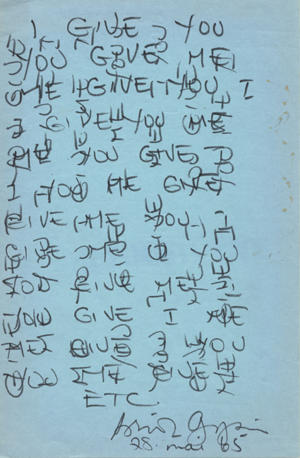
JW Veldhoen had written me asking what I thought of Brion Gysin.

Wil Murray:
"As for Gysin, truth is, beyond skimming a book on the cut-up method he and Burroughs did that they had at the library in Calgary when I was 17, I haven't read anything by him. I've seen his paintings, and they are often good. The EAG had a retrospective of his a few years back and it was grand.
I feel with him that he was more a painter who handed Burroughs some powerful tools. Although I must say that Burroughs lost the plot with the cut-ups after a while. I cannot shit him for this, working something as far as you can kind of allows you to see more, but at some point I think the process became far too evident and eradicated any of the stellar qualities his prose had.
With my own work, i think that a lot of it comes from Burroughs' cut-ups and how they fermented in my head years before I ever cut into a painting. Less from the world of collage as it existed in painting and visual art, as I found Burroughs' work in this method most interesting when he was doing it to his own words. Sections of Naked Lunch and The Ticket That Exploded where he has not taken every word and thrown it in the blender, but done it in tandem with sections written traditionally and sections where traditional writing is repeated, cut-up.
In my own work, I find this to be a kind of pop-art relationship to my own heroic abstraction, to myself. I had tried to eradicate the Pop influence in my work because I simply couldn't abide by Pop's external scopofiliac eye. Always loved it's treatment of material, though...especially Rosenquist and at time Lichtenstein. Turned inward, I find it very rich.
I don't know if I would count Burroughs' process the same."

JW Veldhoen:
"Thanks for your comments re: Brion. They come close to DC's and my own, actually. Still working it out, but I think all that one can take away is the cut-up itself, and even there the claim to originality doesn't hold, and the cut-up uncovers a counter-method ie. a method wherein nothing is moved, cut-up, or transplanted, but is still not a linear narrative... where parts multiply, and organize according to a systemic logic, rather independent of desire, except as reactions. So I guess I'm working a long fiction/non-fiction (or paraliterary, using the culture slang) explanation of something, which may include more obscurely self-referential and infernally false/true autobiography... but hell if that ain't just writing fiction. The old Hemingway hobbyhorse of "write what you know" always struck me as particularly materialist, and sort of insipid, but as I get older I guess I become more and more interested in the impossibility of writing without the luxury of material, or at least obscuring the make-up of it, hiding it, or distorting it. Maybe this means I should give up on prose already, and try and just work language etc. I guess I'm just too vain? I've always been a dissembler (read liar), but almost never with any malice of forethought for anyone in particular."

Tuesday, March 20, 2007

Tore 'er 'air out: Death Goes To The Disco


The fourth rat's death was saturday morning looney tunes. Arm stretched out in one final grasp for the bread and twist-tie combo. One eye bulging from the pressure on his neck made it look like he had just seen some bugs bunny-type rat in a blonde wig and frilly dress.
As promised, part two:

"It's not true that writing has helped me. During the weeks I worked on the story the story never ceased to work on me. Writing has not been, as I supposed at first, the remembering of a set period in my life but only a constant affectation of remembering in the form of sentences that merely claim detachment. Even now I wake up in the night with a start, nudged out of sleep by something within me, and, breathless with horror, feel myself decomposing from one second to the next. The air in the darkness is so still that things seem to have lost their equilibrium, be torn from their moorings, and once they've floated noiselessly about for a while with no center of gravity they suddenly come crashing down on all sides and smother me. These anxiety attacks make me as magnetic as rotting carrion, and what I experience in place of an indifferent place of well-being, where feelings freely interact with one another, is indifferent, objective terror."

From: Helping Verbs of The Heart by Peter Esterhazy

Sunday, March 18, 2007

Horror. Terror. Herror. Torror


I'm tracking something not mine. Like when I told Ken Moffett that I couldn't paint strength because I had no strong marks that felt like mine. They were all borrowed.
A veil of quiet is all over from the studio and best to keep it and to borrow:
(Didn't want death anywhere near the paintings. Its mention-- with prefix-- in my artist statement makes my asshole close.)
Not mine yet. But then again, when redemption first came up in painting I was priest, paintings were flock, and no sheep un-redeemable(driving on 12th avenue in Vancouver at night, either with Jesse or wanting to tell him or wishing he was the one with me).

"Form in art necessarily is an exertion toward the elimination of fortuitousness and accident and randomness and athwartness, all of that which we may call liveliness-- life being that which doesn't hold still and is recalcitrant to final composure"

""He is a satirist and he is, in a special and restricted sense, an artist, a maker of compositions. The strategies of composition are to be imposed on the deadly chaos of what we may call the facts of life. But Hawkes is also exceedingly stringent in his perceptions, and he will not either reduce the difficulties of the enterprise or meliorate the paradox. The fact is that the strategies of composition never really work-- with the result, for form, by the way, that these intensely composed fictions remain at the quite open-ended and provisional, no less than in the novels, let us say, of Saul Bellow. The dynamic of Hawkes' fictions is this: aesthetic form-- which is to say, art-- is set forth to subdue nightmare randomness, and succeeds only to the point of the contingency of the next and inevitable eruption of that randomness. The stakes are these: art finally implies death, but so does the violence of our lives. And there is a paradigm here: society itself, or history itself, is the deathly imposition of harmonies on human will (the source of which, according to Schopenhauer, is the genitals), on that human willfulness which lacking ht deathly imposition of harmonies commits murders"

From: The Satyr At The Head Of The Mob by Marcus Klein
Published in: A John Hawkes Symposium: Design and Debris. NDP446

PS. There will be a second part to this post tomorrow. I left "Helping Verbs of The Heart" by Peter Esterhazy at the laundromat, and am not one to remember quotes verbatim.

Tuesday, February 06, 2007

She was imaginary. And so was my folly. And her words too.


Anonymous comment on "Coming Soon. & On rats. From Daddy Wolf. From James Purdy.":
Yes, well it's redemption, isn't it, you expect chaos, you get order instead. Unment expectations. Miracles.

My response, written today at the laundromat(where I am without a computer):
The unaffected shrug I read in your words about redemption is seductive.
Like the relief of taking your first cigarette from someone older who assures you that it is just a cigarette. So relieved not to have to rake yourself over the coals, you can ignore the implication in their words that there are bigger things to worry about and just sit and smoke.
I would have done horrible things for Quatorze when she used to visit. Because of her shrug.
It is her shrug I read in your words.

Falling back on the chaise longue with a loud sigh at at the mention of miracles is careless and bizarre. Miracles reside well beyond the boundaries of intention and accident.
Your unmeant miracles suggest the diminishment or compression of meaning used to hasten sentimentality by admen trying to sell me something. I read in your sigh something more affected and distanced than tragedy or romance; that is, the self-conscious adoration of the romantic and tragic. I would venture that if it were miracles you were speaking of your cynicism would be impossible.

Saturday, January 27, 2007

Coming Soon. & On rats. From Daddy Wolf. From James Purdy.


"I don't object to animals, see. If it had been Mama Bird, say, which had come out of the hole, I would have had a start, too, as Mama Bird is seldom about and around at that hour, not to mention it not nesting in a linoleum hole, but I think i feel the way I do just because you think of rats along with neglect and lonsomeness and not having nobody near or around you"


Photos by James Schidlowsky

Saturday, January 20, 2007

Sleep Does Not Have His House: Anna Kavan

A very rare bout of insomnia seems like the perfect time to discuss dreams.
Well, I did sleep for a few hours and woke up after a particularly vivid dream. Which I will not describe.
I ask that no one, ever, describe to me their dreams.
The Drowned World by Ballard was abandoned for placing a description of a character's dream on the first or second page.
Dreams, described in words, are inevitably wooden and exhausting, or far too fantastic and elaborate. It simply takes too long to describe in words what dreams provide instantaneously.
They are fast. We all know what they feel like. They are written so badly.
I have bought myself "Sleep Has His House" by Anna Kavan, due in no small part to the album which shares this title and a smashing author's photo. It looked like what I read.
Written in the third person, in the present tense, and consisting mostly of descriptions of dreams interspersed with biographical remembrances, I am finding it impossible.
It is missing terror and softness. The biographical bits become rafts. If she is to sit with me and the dreams described as if we were both seeing it for the first time, they are meaningless.
Without you, there's nothing in your dreams for me.

Wednesday, January 17, 2007

The Adoration of Sickness

"You are wrong that it was long ago I gave up thinking anything could be worked out on the surface. I have found it out, like everybody else, the hard way and only in the last years as a result of I think two things, sickness and success. One of them alone wouldn't have done it for me but the combination was guaranteed. I have never been anywhere but sick. In a sense sickness is a place, more instructive than a long trip to Europe, and it's always a place where there's no company, where nobody can follow. Sickness before death is a very appropriate thing and I think those who don't have it miss one of God's mercies. Success is almost as isolating and nothing points out vanity as well. But the surface hereabouts has always been flat. I come from a family where the only emotion respectable to show is irritation. In some this tendency produces hives, in others literature, in me both"
-Flannery O'Connor, 1956

Saturday, January 06, 2007

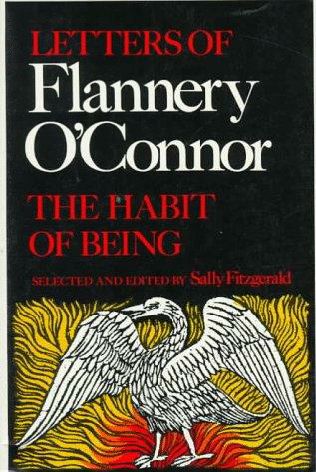
The Letters Of Flannery O'Connor


On a recommendation from a friend I picked up a copy of "The Habit Of Being". Al selection of Flannery O'Connors letters from 1948-1964.
Feeling as if I have backed into my own Catholicism, this book is becoming something like sacred. As I described to Alex St. Onge the other night, it is not that I am seeking to return to Catholicism, more that I am finding that while I tried in many ways to empty my heart, it remained full and that hurt....all along I was Catholic with my eyes lowered to the horizon, but knew the horizon for what it was only because I knew what was above.
This all goes over like a lead balloon at parties. A fitting quote from the book mentioned above:

"I was once, five or six years ago, taken by some friends to have dinner with Mary McCarthy and her husband, Mr. Broadwater. (She wrote that book, A Charmed Life) She departed the Church at the age of 15 and is a Big Intellectual. We went at eight and at one, I hadn't opened my mouth once, there being nothing for me in such company to say. The people who took me were Robert Lowell and his now wife, Elizabeth Hardwick. Having me there was like having a dog present who had been trained to say a few words but overcome with inadequecy had forgotten them. Well, toward morning the conversation turned to the Eucharist, which I, being the Catholic, was obviously supposed to defend. Mrs. Broadwater said that when she was a child and received the Host she thought of it as the Holy Ghost. He being the "most portable" person of the Trinity; now she thought of it as a symbol and implied that it was a pretty good one. I then said, in a very shaky voice, "Well, if it is a symbol, to hell with it." That was all the defense I was capable of but I realize now that this is all I will ever be able to say about it, outside of a story, except that it is the center of my existence for me; all the rest of life is expendable."

It is that final sentence. Qualified by "outside of a story" that sets my head on fire.

Saturday, December 02, 2006

Days unravel nicely.

I find that I don't really read anything online, just skim.
This means that I mistake comments on blogs for blog content.
This was the case with seeing the following on Dennis Cooper's blog:
"Other folks I know manage blogs that might interest regular readers here, and yourself. I like a blog called vananodyne, and the blog maintained by painter Wil Murray... I share some connections with both of these people, but WTF, I admire them and this will probably be my last post here..."

I am delighted by having spent the day trying to figure out where this Mr. Cooper would have seen my work, and why he would express admiration for me. I decided to try to find some of his work and read it. I really had a lovely time.... and found a good blog.
I invited him for a studio visit if he were ever in Montreal and he expressed interest.

The comments were in fact made by a friend in Vancouver, John Veldhoen(whose expression of admiration is well appreciated).

This is not unlike how paintings get made. Whole series of actions based on all kinds of assumptions and conclusions made without sufficient information. I have always said that a huge component of my work is my absolute hatred of researching things properly in order to properly replicate them. I am more able to suss out a version with what I have readily available to me in the studio. In the end, I never wind up with the thing I am attempting to do, but rather some frankenstein that has far more to do with the rash and the ridiculous than the original object, or the desire to replicate it. That fleeting time where you build a fuck of a lot on something you're not even looking at anymore, or checking for stability.

Hyperbolic mistakes , and the arrogance they provide take me where I didn't know I wanted to be.

Tuesday, October 10, 2006

In the meantime

While I am preparing for the opening of my exhibition in Ottawa on the 4th of November, I am doing little writing.
Here's some borrowed content of interest:

- John Hawkes Interview from 1979

- The New Pantagruel, an online magazine I have followed for the past couple of years, now defunct. The goodbye message on their home page is a beautiful piece of writing. I also recommend the essay "On Beginning In Gladness" by James V. Schall, S.J.

Wednesday, September 20, 2006

Thanks to Flannery O'Connor: A Redemption Song

In the narrative of creation the painter lives with each painting multiple lives of varying lengths. Each painting, with its life lived has a narrative of creation whose length is determined by the time it takes to find redemption. Or the end is following a completely separate track, redemption is decided upon the end.

The relief of the end of the painting is the bliss of redemption. No longer suffering the delights and terrors of unsustainable marks and impermanent compositions, constant promise and threat of irrelevancy of a very real and well-documented present. Pathologize the marks you mythologized yesterday. Happy and silent, ignore the triumphant false end of yesterday.

But was I relieved every time? Was I redeemed? Shit, I can’t remember. Do it again. Maybe the next painting will simply never end.

The end, the redemption leaves me two questions:

1. Does the redemptive end of the painting result from every mark made, the complete creation narrative of the painting?

2. Does the redemptive end of the painting result only from those marks intended to procure redemption upon the end?

Tuesday, September 19, 2006

Barnes Mann and Hawkes

Most of my thoughts, written down in gaps between customers on dozens of small notebook pages at the Laundromat, are occupied with two subjects: narrative and redemption, and how each relates to the other and to painting. This will be most of the content of this blog. The small pieces that are by-product of this thinking.


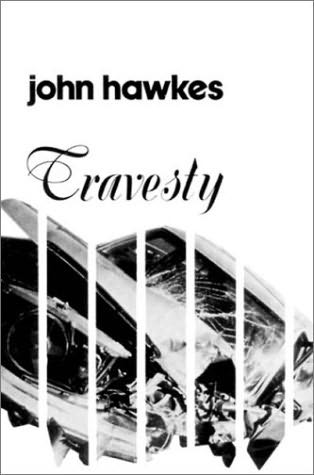
These thoughts are infected with the writing of three authors: Djuna Barnes, Thomas Mann, and John Hawkes.