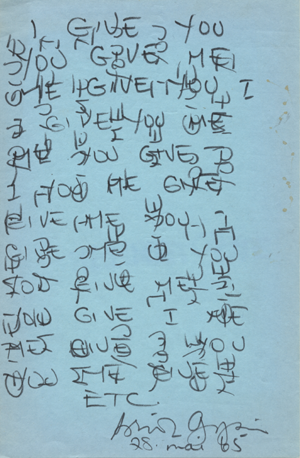
JW Veldhoen had written me asking what I thought of Brion Gysin.
Wil Murray:
"As for Gysin, truth is, beyond skimming a book on the cut-up method he and Burroughs did that they had at the library in Calgary when I was 17, I haven't read anything by him. I've seen his paintings, and they are often good. The EAG had a retrospective of his a few years back and it was grand.
I feel with him that he was more a painter who handed Burroughs some powerful tools. Although I must say that Burroughs lost the plot with the cut-ups after a while. I cannot shit him for this, working something as far as you can kind of allows you to see more, but at some point I think the process became far too evident and eradicated any of the stellar qualities his prose had.
With my own work, i think that a lot of it comes from Burroughs' cut-ups and how they fermented in my head years before I ever cut into a painting. Less from the world of collage as it existed in painting and visual art, as I found Burroughs' work in this method most interesting when he was doing it to his own words. Sections of Naked Lunch and The Ticket That Exploded where he has not taken every word and thrown it in the blender, but done it in tandem with sections written traditionally and sections where traditional writing is repeated, cut-up.
In my own work, I find this to be a kind of pop-art relationship to my own heroic abstraction, to myself. I had tried to eradicate the Pop influence in my work because I simply couldn't abide by Pop's external scopofiliac eye. Always loved it's treatment of material, though...especially Rosenquist and at time Lichtenstein. Turned inward, I find it very rich.
I don't know if I would count Burroughs' process the same."
JW Veldhoen:
"Thanks for your comments re: Brion. They come close to DC's and my own, actually. Still working it out, but I think all that one can take away is the cut-up itself, and even there the claim to originality doesn't hold, and the cut-up uncovers a counter-method ie. a method wherein nothing is moved, cut-up, or transplanted, but is still not a linear narrative... where parts multiply, and organize according to a systemic logic, rather independent of desire, except as reactions. So I guess I'm working a long fiction/non-fiction (or paraliterary, using the culture slang) explanation of something, which may include more obscurely self-referential and infernally false/true autobiography... but hell if that ain't just writing fiction. The old Hemingway hobbyhorse of "write what you know" always struck me as particularly materialist, and sort of insipid, but as I get older I guess I become more and more interested in the impossibility of writing without the luxury of material, or at least obscuring the make-up of it, hiding it, or distorting it. Maybe this means I should give up on prose already, and try and just work language etc. I guess I'm just too vain? I've always been a dissembler (read liar), but almost never with any malice of forethought for anyone in particular."

