 In Montreal
Wednesday, May 23, 2007


Friday, May 18, 2007
Forced feeding leads to excessive thinness (effete)
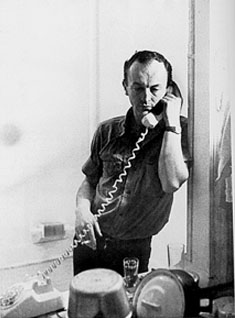
Stopping in on a friend(the same one who passed me Jackson Mac Low) at work the other day, we were discussing an interview I did with Jacqueline Mabey for a show in Vancouver next year. In the middle of all the marveling at my surprising lack of childhood dreams of a painter's life(I can remember wanting to be a rock star, an elephant and a fighter pilot), and my non-phenomenal relationship to art-making, he jumped up excited to show me this great bit of writing on his computer:
"Everything is in the poems, but at the risk of sounding like the poor wealthy man’s Allen Ginsberg I will write to you because I just heard that one of my fellow poets thinks that a poem of mine that can’t be got at one reading is because I was confused too. Now, come on. I don’t believe in god, so I don’t have to make elaborately sounded structures. I hate Vachel Lindsay, always have, I don’t even like rhythm, assonance, all that stuff. You just go on your nerve. If someone’s chasing you down the street with a knife you just run, you don’t turn around and shout, "Give it up! I was a track star for Mineola Prep."
That’s for the writing poems part. As for their reception, suppose you’re in love and someone’s mistreating (mal aimé) you, you don’t say, "Hey, you can’t hurt me this way, I care!" you just let all the different bodies fall where they may, and they always do ‘flay after a few months. But that’s not why you fell in love in the first place, just to hang onto life, so you have to take your chances and try to avoid being logical. Pain always produces logic, which is very bad for you.
I’m not saying that I don’t have practically the most lofty ideas of anyone writing today, but what difference does that make? they’re just ideas. The only good thing about it is that when I get lofty enough I’ve stopped thinking and that’s when refreshment arrives.
But how can you really care if anybody gets it, or gets what it means, or if it improves them. Improves them for what? for death? Why hurry them along? Too many poets act like a middle-aged mother trying to get her kids to eat too much cooked meat, and potatoes with drippings (tears). I don’t give a damn whether eat or not. Forced feeding leads to excessive thinness (effete). Nobody should experience anything they don’t need to, if they don’t need poetry bully for them, I like the movies too. And all, only Whitman and Crane and Williams, of the American are better than the movies. As for measure and other technical apparatus, that’s just common sense: if you’re going to buy a of pants you want them to be tight enough so everyone will want to go to bed with you. There’s nothing metaphysical about it. Unless of course, you flatter yourself into thinking that what You’re experiencing is "yearning."
Abstraction in poetry, which Allen recently commented on in It is, is intriguing. I think it appears mostly in the minute particu1ars where decision is necessary. Abstraction (in poetry, not in painting) involves personal removal by the poet. For instance, the decision involved in the choice between "the nostalgia of the infinite" and "the nostalgia for the infinite" defines an attitude toward degree of abstraction. The nostalgia of the infinite representing the greater degree of abstraction, removal, and negative capability (as in Keats and Mallarmé). Personism, a movement which I recently founded and which nobody yet knows about, interests me a great deal, being so totally opposed to this kind of abstract removal that it is verging on a true abstraction for the first time, really, in the history of poetry. Personism is to Wallace Stevens what la poésie pure was to Béranger. Personism has nothing to do with philosophy, it’s all art. It does not have to do with personality or intimacy, far from it! But to give you a vague idea, one of its minimal aspects is to address itself to one person (other than the poet himself), thus evoking overtones of love without destroying love’s life-giving vulgarity, and sustaining the poet’s feelings towards the poem while preventing love from distracting him into feeling about the person. That’s part of personism. It was founded by me after lunch with LeRoi Jones on August 27, 1959, a day in which I was in love with someone (not Roi, by the way, a blonde). I went back to work and wrote a poem for this person. While I was writing it I was realizing that if I wanted to I could use the telephone instead of writing the poem, and so Personism was born. It’s a very exciting movement which will undoubtedly have lots of adherents. It puts the poem squarely between the poet and the person, Lucky Pierre style, and the poem is correspondingly gratified. The poem is at last between two persons instead of two pages."
[9/3/59]
Frank O’Hara "Personism: A Manifesto" from Yugen #7, copyright © 1961.
Sunday, May 13, 2007
Screaming at rainbows or pregnant women

I met J. on what was my headiest trip home for Christmas. We spent a few days in the entry way of a door left unguarded, and I came home to Montreal.
I started to pour myself into the mailbox across the street, and the one at the post office, hoping that some far-off mailman would, in turn, pour me into hers or retrieve her to come flopping and rubber chicken like out of my mailbox. We spoke on the phone, she didn't write back.
Months passed happily this way.
I went back to Calgary, to be terrified by the gaps that lay between her and the her I'd been writing to, and me and the me who'd been writing. We stopped speaking. I continued to write her and then stopped. I began writing here, in the beginning I was still writing on this blog to her.
I had never written so much, and the beauty of letters is that I can't even remember anything from them besides fragments. My house is filled with unsent letters, they surprise me stuffed in books and drawers.
To sit and write to someone, unanswered(or maybe even unsent), you build a them to write to. And you build a you to write from. To continue to write when no hope of answer exists, you build without any new information, in a vacuum. The she I wrote to was me, in her clothing. The me that I wrote from was me in my clothing. Both imaginary, all me.
Writing those letters changed my relationship to the studio and to working in it.
To find myself having built another's veneer strangely enough to be called "other" was terrifying. I could not even worry about violence done to her, as she had ceased to be another months before. It was terrifying because it was so well built I counted it as another person, as her, for months.
This killed outside. There wasn't and isn't any outside. It is always all me.
Just as the love of love songs is misleading, as the other that is being sung about is the constructed other of the self singing, my attributing otherness to accidents in painting was misleading as I have spent years in the studio, and those years have built control.
As I constructed a veneer of J. to cover the mysteries I couldn't access because of silence, I constructed a veneer of accident to cover the mysteries of what paint did when I wasn't looking, touching, acting.
In the end the only unintentional part was the construction of the veneers because it is too slow to see and works seamlessly from some space where you can claim knowing.
At some point I was near enough to J. and accident to name them, now those theys go by the names "me" and "me" because in stopping writing to her, and in stopping chasing fleeting accident, nothing is left but the veneer.
Saturday, May 12, 2007
Calgary Andrew Number One
 Always a pleasure to see Andrew Wedderburn, a man not too scared to sleep in my apartment.
He introduced me to the term "dorkestra", in reference to all the glockenspiel and high school band instrument mega-groups this city has pollinated across the land.
Your back and my front.

It is sad and thirst-making to see the something an artist has made eclipsed by the back of them, standing as viewer between me and the work.
The work is pre-viewed. I am not, then, viewer. I am spectator to the artist-as-viewer viewing his own work. I am a third, not a second.
Eclipsed, I cannot even say that the work exists, but must take on faith its existence by the artist-as-viewers back there in front of me, not staring me down.
Sometimes the head turns, and over his shoulder is yelled "It's blue!" or "It's Lacan!".
Magic eight ball back.
Friday, May 11, 2007
Subscribe to:
Posts (Atom)