Friday, March 30, 2007

Tuesday, March 27, 2007

Thursday March 29th: MECC 3rd Anniversary

I will be in attendance, have some pieces in the show and will be included in the auction.

Monday, March 26, 2007

Sloppy Seconds Wedderburn


Andrew is the only friend of mine who pointed to comet the night we met.
He has a book coming out on Coach House. He's touring the book, reading; as opposed to his usual tours yodelling with Hot Little Rocket.


Milk Chicken Bomb

The kid sells lemonade. Not a lot of people buy lemonade, especially now that it’s winter, but the kid makes good lemonade, even if his friend Mullen thinks it ought to be sweeter.

They don’t talk much with the other ten-year-olds – most of the others are Dead Kids anyway. Except for Jenny Tierney, but she’s busy breaking kids’ faces with her math book. Besides, the Russians from the meat-packing plant are a lot cooler, and they always win at curling.

But in small-town Alberta, there are just too many roman-candle fights, bonspiels, retaliatory river diversions, black-market submarines, exploding boilers, meat-packing-plant suicides and recess-time lightning strikes for one lonely kid to get any attention. He might as well go to Kazakhstan. Then the adults in his life start disappearing down tunnels and into rendering vats. Being ten is hard enough without all that, especially when your best friend is ruining the lemonade.

But the Milk Chicken Bomb should change everything.

Frenetic, hilarious and gently heartrending, The Milk Chicken Bomb takes us inside the mind of a troubled ten-year-old who is just beginning to understand that the adults around him are as lonely and bewildered as he is in the face of the slapstick demands of the world.

Simpleposie blog

I was asked to guest-star some questions on Simpleposie's blog this week.
Check it and answer those burning questions that flew into my head last week.

Sunday, March 25, 2007

A conversation with JW Veldhoen: Part Two


Wil Murray:
"The counter method bit is interesting. I though a bit about the cut-up and wonder if it is just a more mechanical extension of what one already does when writing. Moving things around, reading, moving them again. But writing that I wonder if the cut-up extends it to 'looking' instead of 'reading'. A relationship somewhere between viewing and reading.
There's little of interest in the book of essays on John Hawkes I just got, but one thing sticks in my head. The interviewer goes on for a while about the strangeness of Hawke's first book being non-biographical, as most are. He had no grand reply, and described the day that the book was started. I think a lot lately about the lack of importance that I ascribe to the specifics of what I am doing in the studio when "painting is going well". It could just as easily be blue and flat or brown and glossy and there's simply no place that isn't me.
Making fog horn sounds as I wave my hand over some great lump of paint. No one is ever going to do that but me.
I think Hemingway meant his famous words to be about writing in good faith, less than 'if you're going to write a cock, write YOUR cock'. I, just the other month, picked up a brush and started rendering form. I am an unpracticed hack. The only strategy is to be one until I'm not."

JW Veldhoen:
"This(Pascal's Wager) is probably as close as I've ever come to a method for living, and I've used it as advise to myself and for others. If you find yourself lacking belief, perhaps by acting as though you believe, maybe you'll trick yourself. This also allows for the transference of belief, and the wearing of masks. Rilke said people run out of masks, and I hope not to. This of course opens up a whole can of worms regarding self-deception, or bad faith, but I've dumped constant existentialist anxiety for what seem like palliative (a treatment or medicine relieving pain or alleviating a problem without dealing with the underlying cause, from Latin palliativus, from the verb palliare ‘to cloak’) or destructive actions. As for 'write what you know' I guess my point goes to how I practice creative writing, and against how so many think that slavish imitation of life, or observation alone, is a high enough criteria for experiential prose, and how a so-called 'true-story' or a story transmogrified from the base components of happenstance, equals authorial and narrative consistency, or honesty, as a opposed to an elaborate dissemblance (especially one that might take on the appearance of truth to the author) that illustrates a variety of truth (a well-worn chestnut).

And when I wrote, 'a method wherein nothing is moved, cut-up, or transplanted, but is still not a linear narrative... where parts multiply, and organize according to a systemic logic, rather independent of desire, except as reactions.' I was attempting to translate half-digested and voguish theory into something far more elusive and personal. This systemic logic is varied, indecipherably hermetic, and is why I can't really compose a methodology for narrative. I've used formal tricks for effect (anagrams, word games and puns, words for sound vs. words for meaning, issuing in something akin to aphasia), or I've used bodies of reference and discourse related to keywords (ie. pre-twentieth century American gothic literature and "witches") but then I manipulated my work, worked my work, almost sculpturally, or at times thinking of it as a performance. Lately though I've shifted into a linear narrative mode where structure accedes to fable, and a set of different conceits for rendering form, not so dissimilar to your "picking up a brush". Although I doubt your word "hack" as your hand has a memory, with your eyes, and perception and rendition are linked. People used to call it taste before they became exhausted and silent. Likewise, as I struggle with fable and story, I can't ignore outpouring, indirection, or what a number of contemporaries have called 'aimlessness.' "

A conversation with JW Veldhoen: Part One


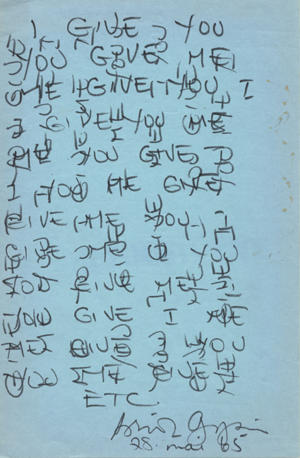
JW Veldhoen had written me asking what I thought of Brion Gysin.

Wil Murray:
"As for Gysin, truth is, beyond skimming a book on the cut-up method he and Burroughs did that they had at the library in Calgary when I was 17, I haven't read anything by him. I've seen his paintings, and they are often good. The EAG had a retrospective of his a few years back and it was grand.
I feel with him that he was more a painter who handed Burroughs some powerful tools. Although I must say that Burroughs lost the plot with the cut-ups after a while. I cannot shit him for this, working something as far as you can kind of allows you to see more, but at some point I think the process became far too evident and eradicated any of the stellar qualities his prose had.
With my own work, i think that a lot of it comes from Burroughs' cut-ups and how they fermented in my head years before I ever cut into a painting. Less from the world of collage as it existed in painting and visual art, as I found Burroughs' work in this method most interesting when he was doing it to his own words. Sections of Naked Lunch and The Ticket That Exploded where he has not taken every word and thrown it in the blender, but done it in tandem with sections written traditionally and sections where traditional writing is repeated, cut-up.
In my own work, I find this to be a kind of pop-art relationship to my own heroic abstraction, to myself. I had tried to eradicate the Pop influence in my work because I simply couldn't abide by Pop's external scopofiliac eye. Always loved it's treatment of material, though...especially Rosenquist and at time Lichtenstein. Turned inward, I find it very rich.
I don't know if I would count Burroughs' process the same."

JW Veldhoen:
"Thanks for your comments re: Brion. They come close to DC's and my own, actually. Still working it out, but I think all that one can take away is the cut-up itself, and even there the claim to originality doesn't hold, and the cut-up uncovers a counter-method ie. a method wherein nothing is moved, cut-up, or transplanted, but is still not a linear narrative... where parts multiply, and organize according to a systemic logic, rather independent of desire, except as reactions. So I guess I'm working a long fiction/non-fiction (or paraliterary, using the culture slang) explanation of something, which may include more obscurely self-referential and infernally false/true autobiography... but hell if that ain't just writing fiction. The old Hemingway hobbyhorse of "write what you know" always struck me as particularly materialist, and sort of insipid, but as I get older I guess I become more and more interested in the impossibility of writing without the luxury of material, or at least obscuring the make-up of it, hiding it, or distorting it. Maybe this means I should give up on prose already, and try and just work language etc. I guess I'm just too vain? I've always been a dissembler (read liar), but almost never with any malice of forethought for anyone in particular."

Tuesday, March 20, 2007

Tore 'er 'air out: Death Goes To The Disco


The fourth rat's death was saturday morning looney tunes. Arm stretched out in one final grasp for the bread and twist-tie combo. One eye bulging from the pressure on his neck made it look like he had just seen some bugs bunny-type rat in a blonde wig and frilly dress.
As promised, part two:

"It's not true that writing has helped me. During the weeks I worked on the story the story never ceased to work on me. Writing has not been, as I supposed at first, the remembering of a set period in my life but only a constant affectation of remembering in the form of sentences that merely claim detachment. Even now I wake up in the night with a start, nudged out of sleep by something within me, and, breathless with horror, feel myself decomposing from one second to the next. The air in the darkness is so still that things seem to have lost their equilibrium, be torn from their moorings, and once they've floated noiselessly about for a while with no center of gravity they suddenly come crashing down on all sides and smother me. These anxiety attacks make me as magnetic as rotting carrion, and what I experience in place of an indifferent place of well-being, where feelings freely interact with one another, is indifferent, objective terror."

From: Helping Verbs of The Heart by Peter Esterhazy

Sunday, March 18, 2007

Horror. Terror. Herror. Torror


I'm tracking something not mine. Like when I told Ken Moffett that I couldn't paint strength because I had no strong marks that felt like mine. They were all borrowed.
A veil of quiet is all over from the studio and best to keep it and to borrow:
(Didn't want death anywhere near the paintings. Its mention-- with prefix-- in my artist statement makes my asshole close.)
Not mine yet. But then again, when redemption first came up in painting I was priest, paintings were flock, and no sheep un-redeemable(driving on 12th avenue in Vancouver at night, either with Jesse or wanting to tell him or wishing he was the one with me).

"Form in art necessarily is an exertion toward the elimination of fortuitousness and accident and randomness and athwartness, all of that which we may call liveliness-- life being that which doesn't hold still and is recalcitrant to final composure"

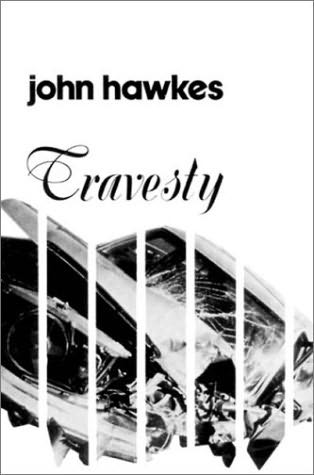
""He is a satirist and he is, in a special and restricted sense, an artist, a maker of compositions. The strategies of composition are to be imposed on the deadly chaos of what we may call the facts of life. But Hawkes is also exceedingly stringent in his perceptions, and he will not either reduce the difficulties of the enterprise or meliorate the paradox. The fact is that the strategies of composition never really work-- with the result, for form, by the way, that these intensely composed fictions remain at the quite open-ended and provisional, no less than in the novels, let us say, of Saul Bellow. The dynamic of Hawkes' fictions is this: aesthetic form-- which is to say, art-- is set forth to subdue nightmare randomness, and succeeds only to the point of the contingency of the next and inevitable eruption of that randomness. The stakes are these: art finally implies death, but so does the violence of our lives. And there is a paradigm here: society itself, or history itself, is the deathly imposition of harmonies on human will (the source of which, according to Schopenhauer, is the genitals), on that human willfulness which lacking ht deathly imposition of harmonies commits murders"

From: The Satyr At The Head Of The Mob by Marcus Klein
Published in: A John Hawkes Symposium: Design and Debris. NDP446

PS. There will be a second part to this post tomorrow. I left "Helping Verbs of The Heart" by Peter Esterhazy at the laundromat, and am not one to remember quotes verbatim.

Thursday, March 15, 2007

Dots or Stripes. Stripes or Dots.


Insomnia is funny.
In a recent conversation with Jesse I mentioned that every painting hits a point where in order to continue, some time has to be spent laboriously painting. Specifically laborious. Recently...well, for years...this has meant dots(variously masked, painted freehand, layered) or stripes(of all widths, regular, irregular, layered).
The conversation took a turn that put this in some moral light, but I think that forgets a lot for the sake of a very pop psychology interpretation of what goes on.
My words: "Like I've been coasting too long(in the making of the painting) on flash moves.
Jesse's: "Funny how that moral thing comes up"

A much larger recent concern of mine. Well beyond this conversation.
There's really no reason to do anything to a painting. it doesn't particularly matter what I do do to it.
It isn't moral because it is not yet anything. Supposing that anything I do to a painting will do anything is at best fleeting. I will do more or not do more. There is no grand narrative to weigh any mark's value, or not one yet.
The studio is a kind of non-space. There's no eyes, and there's no secrets because there's simply no one around to keep a secret from. I try at once to disappear and treat the painting like something other than me.
The labour is not so neurotic. Only the soreness of my back and staggering blindness exiting the studio differentiate these nights from others.

I have great difficulty connecting the dots. It all comes out like nihilism, but I mean to say it all with a lilting tone.
I cannot see the future from my studio window, or looking in to it. Hell, even the paintings won't give up the ghost until the end.

Monday, March 05, 2007

Ode to My Mom: Observation Nurseries of Calgary


Even my immersion in it was complete, and aimless. There was no outside, no space that wasn't in it.
My Mom worked for, and eventually directed a non-profit society in Calgary called Observation Nurseries of Calgary. Their method, as I remember it, was to form a once-a-week space in church basements around town where children, brought by their mom, were allowed to travel through the various activity areas(water table, sand table, painting), undirected, aimlessly, minimally monitored. At the end of the day we would sing together, the only prescribed activity.
Given that it was my Mom who worked there, this unstructured play and its value was present daily for both me and my sister, Amy. Not once-a-week in church basement, but the usual quotidian state of things in our house.
We were not a particularly hippy family. While I can still taste wheat germ and sugar-free health food lollipops, we had nothing on some folks I know.
Left to my own devices in play, structured activities always felt cursory and un-involved. If I could not spend the whole day at something because someone was encouraging me to move on to something else, it was too distancing for me to ever feel like something I had actually done. A personal relationship to something was impossible from the start if the end was pre-determined.
In art school, I started to explore the aimless in painting. My artist statements began to contain lines about the disappointment I felt at achieving anything I had intended to accomplish. Goaless painting, aimless work was so outside the mode of work I saw all around me that I believed I had thought it up myself with a little help from Heather Kvill's description of the methodology of Graham Peacock.
Years later it dawned on me that Mom had been a major influence on this way of working.
These days I never get to the studio if an end to the hours spent there is pre-determined. I will never meet anyone for drinks "after the studio" if the want me to be anything besides resentful for their having capped my aimlessness. While the purity of aimless work is always eroding and and returning, it never leaves my practice.
I mistrust directed activities, sketches, and costumes.
There's some rigorous patience that this bred.
There's something there too, just beyond my fingertips that is about duration and solitude and why I can paint again and again.
Truthfully, it may be because of my failure at my first chosen vocation. After asking me what I would like to be when I grew up, my sister complained to my Mom about my ridiculous choice. She answered in deadly seriousness: "He can be whatever he wants when he grows up, even an Elephant".

PS. Thinking about this, and having some conversations with my sister about it, I find that another common theme in my work -or at least its existence as thing-to-be-looked-at- has some ties to this.
The difference I often speak of between anyone and everyone. Or "for everyone" and "for anyone"(the prettiest chasm). I cannot yet connect this and that, but feel the juicy strings between them. Maybe that whole wolf-in-sheep's-clothing, sheep-in-wolf's-clothing, wolf-in-wolf's-clothing, sheep-in-sheep's-clothing, sheep, old wolf friend called "accident and intention".

Friday, March 02, 2007

When I drink, I pink.


Contrary to what this image might suggest, Jesse Proudfoot is my best friend. Taken at my 29th birthday party
From Erin Sheehan's Photos.